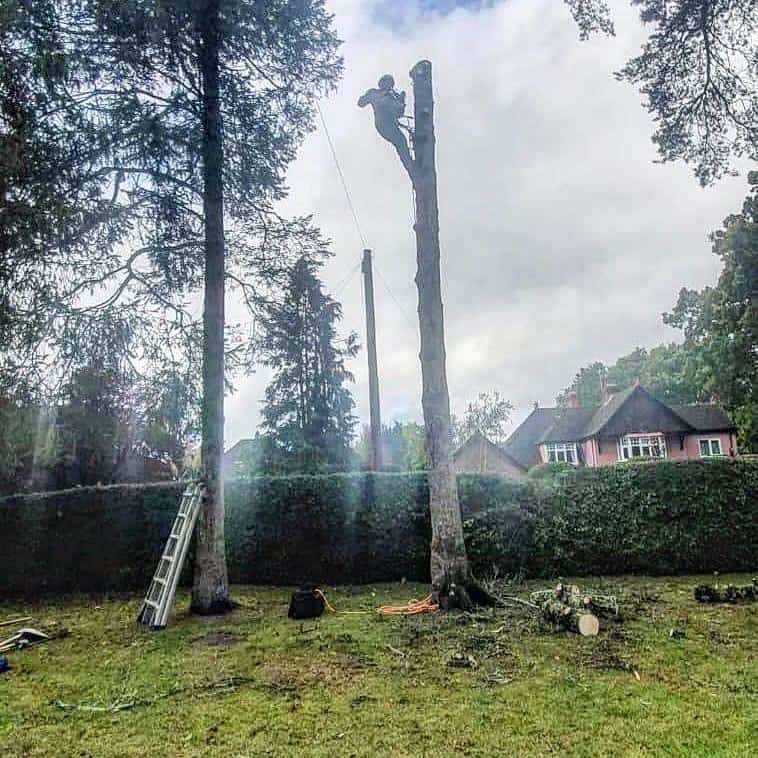
A mature tree can be one of the most attractive features of a garden, providing height, character, greenery and a strong sense of permanence. However, trees continue developing long after they have become established, and a specimen that once fitted comfortably within its surroundings can eventually begin to look disproportionately large for the available space.
For homeowners in Liphook, Hampshire, this does not necessarily mean that the tree needs to be removed. Where the tree is suitable and its condition allows, professional crown reduction can provide a controlled way of reducing the overall size of the canopy while retaining the tree as an important garden feature.
At LM Tree Surgery Liphook, crown reduction is approached according to the individual tree, its structure and its position within the property.
What Is Crown Reduction?
Crown reduction is a professional tree surgery technique used to reduce the overall dimensions of a tree’s canopy.
Rather than simply removing branches randomly or cutting the tree back to an arbitrary height, carefully selected branches are shortened to suitable growth points. The intention is to create a smaller crown while maintaining an appropriate natural form.
Depending on the tree and the reason for the work, crown reduction may involve decreasing:
- Overall height
- Crown spread
- The length of particular branches
- Excessive growth towards buildings or garden areas
- The dimensions of an unbalanced section
Good crown reduction is selective. It should respond to the structure of the individual tree rather than treating every branch in exactly the same way.
When Does a Tree Start Becoming Too Large for Its Position?
There is no single height or canopy width at which a tree automatically becomes too large.
A large tree standing in a spacious position may remain entirely appropriate, while a much smaller specimen in a restricted garden could begin causing practical problems.
The relationship between the tree and its surroundings matters most.
Professional assessment may be worthwhile when you notice that the canopy is:
- Extending increasingly close to the property
- Spreading significantly across the garden
- Reaching over frequently used areas
- Becoming difficult to accommodate within the available space
- Developing disproportionately long branches
- Creating a noticeably unbalanced appearance
- Becoming much larger than originally expected
These signs do not automatically mean crown reduction is required, but they provide sensible reasons to have the tree professionally assessed.
Why Not Simply Remove a Large Tree?
A tree becoming larger does not automatically mean removal is the best solution.
Established trees can contribute significantly to the appearance and character of a garden. If the tree remains suitable for retention, professional management may allow homeowners to keep those benefits while addressing excessive canopy size.
Crown reduction can therefore provide a useful middle ground between leaving a tree completely unmanaged and removing it altogether.
The correct solution depends on the individual tree. Its species, condition, structure, location and the extent of the requested reduction all need consideration.
Crown Reduction Can Restore Better Proportions
One of the main reasons for crown reduction is to bring the scale of a tree into better proportion with its surroundings.
A canopy that dominates a relatively compact garden can make the outdoor space feel crowded. Long lateral branches may extend over lawns, patios or other garden features, while excessive upper growth can make the tree visually overpowering.
Selective reduction can help establish a more balanced relationship between the tree and the property.
Importantly, the aim should not be to make a mature tree unnaturally small. The work needs to respect the tree’s existing structure and what can appropriately be achieved.
Managing Branches Growing Towards the Property
As trees mature, branches can gradually extend towards roofs, walls and other parts of a property.
A branch does not necessarily become problematic simply because it points towards a building. However, increasingly restricted clearance can justify professional assessment.
Depending on the circumstances, selective crown reduction may help increase separation while retaining the overall tree.
This requires careful pruning decisions. Removing branches indiscriminately can alter the balance and appearance of the canopy, whereas professional tree surgery considers how each cut contributes to the finished structure.
What If Only One Side of the Tree Is Too Large?
Trees do not always develop evenly.
Light availability, surrounding vegetation and available growing space can influence the direction in which branches develop. One part of the crown may therefore extend considerably further than another.
In these circumstances, the tree may not require an identical reduction across every section.
Selective crown reduction can focus attention where it is genuinely required while considering the overall balance of the canopy.
This is another reason why professional assessment is valuable. Crown reduction should be based on the individual growth pattern rather than simply removing a fixed amount from every side.
Crown Reduction Is Different From General Tree Cutting
The term “cutting back” can make crown reduction sound straightforward, but appropriate tree pruning requires much more thought.
Professional crown reduction considers factors such as:
Tree Species
Different species have different growth characteristics and pruning tolerances.
Branch Structure
The position, diameter and relationship of individual branches influence where suitable pruning cuts can be made.
Overall Condition
The health and structural condition of the tree need to be understood before substantial work is planned.
Desired Outcome
The reason for reducing the crown should guide the extent and location of pruning.
Future Growth
Tree surgery should consider how the remaining crown is likely to continue developing.
These factors help determine whether crown reduction is appropriate and how the work should be carried out.
Why Excessive Reduction Can Be Counterproductive
If a tree appears much too large, it can be tempting to request that as much of the canopy as possible is removed in one operation.
More pruning is not automatically better.
Excessive removal can unnecessarily alter the tree’s natural form and create a result that does not reflect good tree management. The amount that can appropriately be reduced depends on the tree and its condition.
A professional tree surgeon should therefore recommend a suitable level of reduction rather than simply cutting the crown back as far as possible.
Crown Reduction Can Help With Overextended Branches
Sometimes the overall tree is not the main problem. Instead, several particularly long branches may be making the canopy appear oversized or poorly balanced.
These branches can extend beyond the main crown and place increasing weight further from their points of attachment.
Professional reduction can shorten appropriate branches while retaining suitable growth further back.
The result can be a more compact and balanced canopy without unnecessarily removing large parts of the tree.
Can Crown Reduction Improve the Appearance of a Tree?
When carried out appropriately, crown reduction can improve the proportions of a tree that has begun to dominate its surroundings.
A well-managed canopy should still look recognisably like the same tree.
This is an important distinction between skilled crown reduction and indiscriminate cutting.
The objective is generally to achieve a controlled, balanced result rather than leaving obvious heavy cuts or an unnaturally shaped crown.
For prominent garden trees in Liphook, maintaining this natural appearance can be an important part of the work.
What About Dead or Damaged Branches?
An assessment for crown reduction can also provide an opportunity to identify dead, damaged or otherwise problematic branches within the canopy.
These issues are not the same as excessive tree size, but they may need addressing as part of appropriate tree management.
A professional tree surgeon can distinguish between healthy branches requiring selective reduction and material that needs attention for other reasons.
This allows the work to be planned around the condition of the complete crown rather than focusing solely on reducing its dimensions.
Will Crown Reduction Stop the Tree Growing?
No. Crown reduction does not permanently stop a living tree from growing.
Trees naturally continue developing after pruning, although their response will depend on factors including species, condition and the work carried out.
Homeowners should therefore view crown reduction as part of tree management rather than a permanent method of fixing a tree at one exact size.
Understanding future growth is particularly important where a tree occupies a relatively restricted position.
Why Professional Tree Surgery Matters
Working on a mature tree requires specialist knowledge, appropriate equipment and an understanding of tree structure.
Large branches cannot simply be removed according to which ones appear inconvenient from ground level. Each pruning decision can affect the remaining canopy.
Professional tree surgeons consider how the work will influence:
- Crown balance
- Overall form
- Branch structure
- Future development
- The relationship between the tree and surrounding space
At LM Tree Surgery Liphook, the aim is to recommend tree surgery based on what the individual tree genuinely requires rather than carrying out unnecessary work.
When Should You Arrange an Assessment?
It may be worth asking a professional tree surgeon to assess a tree when:
- The canopy appears disproportionately large for the garden
- Branches are extending increasingly close to the property
- One side has become noticeably overextended
- The crown is taking up considerably more garden space
- You are unsure how much pruning would be appropriate
- Previous cutting has left the canopy uneven
- You want to retain the tree but manage its overall dimensions
An assessment can determine whether crown reduction is appropriate or whether another form of tree surgery would better address the issue.
Professional Crown Reduction in Liphook
Mature trees can remain valuable garden features even when their size starts becoming difficult to accommodate.
At LM Tree Surgery Liphook, we provide professional crown reduction and tree surgery for properties in Liphook, Hampshire. Each tree can be assessed according to its species, condition, structure and relationship with the surrounding property before suitable work is recommended.
The objective is not simply to make trees smaller. It is to manage excessive growth thoughtfully while retaining an appropriate, balanced canopy wherever practical.
Conclusion
When a tree starts looking too large for its property, removal is not necessarily the only option. Professional crown reduction can help decrease excessive height or spread, manage overextended branches and bring the canopy into better proportion with the available garden space.
Successful crown reduction requires careful judgement. The amount of growth removed should reflect the tree’s species, structure, condition and position rather than being based purely on achieving the smallest possible canopy.
If a tree at your property in Liphook, Hampshire, is beginning to dominate the garden or has developed an oversized or unbalanced crown, contact LM Tree Surgery Liphook. We can assess the tree and determine whether professional crown reduction could provide a suitable way to manage its size while retaining it as part of your outdoor space.
Call us on: 01428 770 498
Click here to find out more about LM Tree Surgery Liphook
Click here to complete our contact form and see how we can help with your tree needs.